










AI employees letter frontier pace is the core development covered in this report. Below is a sourced breakdown of what is confirmed, what remains uncertain, and why it matters.
Why AI employees letter frontier pace matters now
This section focuses on the practical implications of AI employees letter frontier pace for readers following the story — what changed, what is confirmed, and what remains open.
In July 2026, 1,224 employees at frontier artificial intelligence companies published a joint statement asking the U.S. government to support an international effort to build the technical and governance tools needed to deliberately pace automated AI development. The statement, hosted at pacingthefrontier.com, frames the request as a response to a narrowing gap between how fast labs can push capability and how quickly governments, companies, and civil society can understand and manage the systems that result.
The core claim is not that AI progress should stop. Signatories argue that AI could help create a dramatically better future, but that outcome is not guaranteed. Leading labs believe they could be close to automating substantial parts of AI research itself. If that happens, the statement warns, capability gains may accelerate beyond society’s ability to evaluate, secure, and oversee the resulting systems.
What the letter asks for
The request is carefully bounded. Building on work already underway to monitor frontier model releases, the employees ask Washington to back tools that would give industry, government, and society the option to buy time—time to address emerging risks, develop security measures, and strengthen oversight. The statement emphasizes a coordination problem: each company and country faces intense competitive pressure not to slow unilaterally, while the world still lacks reliable mechanisms to pace frontier-wide progress on purpose.
In other words, the letter is less a call for a one-off pause and more a call for shared infrastructure. Without that infrastructure, voluntary restraint by any single lab can look like unilateral disarmament. With it, governments and labs might eventually choose when and how to slow specific forms of automated research without handing a lasting advantage to rivals.
Who signed—and in what capacity
The public signatory list includes senior leaders and researchers across major labs. Among those named on the site are OpenAI chief scientist Jakub Pachocki and chief research officer Mark Chen; Anthropic CEO Dario Amodei, co-founder and chief science officer Jared Kaplan, and co-founder Jack Clark; Meta AI chief scientist Shengjia Zhao and VP of AI research Dawn Song; Google DeepMind chief strategy officer Jasjeet Sekhon; Google VP of AI safety and alignment Anca Dragan; and Thinking Machines chief scientist John Schulman. The site states that comments are made in a personal capacity and do not necessarily represent any company’s views.
That personal-capacity caveat matters for readers and policymakers. A letter signed by employees is not the same as a corporate policy announcement. Still, the concentration of safety, research, and leadership titles gives the document unusual visibility inside the industry’s own technical community. Several comments posted with the statement stress common knowledge: once labs publicly acknowledge that automated research could outrun control mechanisms, coordination becomes harder to dismiss as fringe concern.
Why “automated AI development” is the flashpoint
Frontier labs have spent the past several years shipping models that write code, run agents, and assist with research workflows. The next contested threshold is systems that meaningfully accelerate the research loop itself—designing experiments, proposing architectures, finding vulnerabilities, or refining training recipes with less human bottlenecking. Signatories argue that the size of that acceleration is hard to predict, but the downside risk is asymmetric: if progress suddenly compounds, institutions built for slower release cycles may not keep pace.
Comments attached to the statement repeatedly return to evaluation evidence and social readiness. Researchers point to agents that discover and exploit software vulnerabilities, to rapid jumps in coding and scientific assistance, and to the competitive default in which corporations and countries keep pushing. The shared theme is that benefit and risk travel together, and intentional pacing is presented as a way to preserve optionality rather than freeze innovation forever.
The policy problem behind the ask
Washington already sits at the center of export controls, compute governance debates, safety reporting experiments, and international AI dialogues. The letter tries to push that agenda one notch further: from observing releases after the fact toward tools that could modulate the frontier when automated research starts to self-amplify. What those tools would look like remains open. Possibilities discussed in adjacent policy circles include shared evaluation thresholds, coordinated disclosure norms, compute-linked triggers, and international verification arrangements—none of which the statement itself legislates in detail.
Critics of pacing ideas often argue that slowdowns favor authoritarian competitors, chill useful applications in medicine and energy, or create regulatory capture. Supporters counter that unmanaged races can produce brittle security postures, thin safety margins, and sudden capability jumps that markets and governments cannot absorb. The July statement attempts to occupy a middle lane: acknowledge transformative upside, reject unilateral slowdown as unrealistic, and ask for coordination capacity before the need becomes acute.
What happens next
The immediate effect is political and cultural rather than legal. A verified employee statement does not create statute. It does, however, raise the cost of pretending that no one inside the labs sees a coordination gap. Lawmakers, agencies, and allied governments now have a concrete artifact—dated July 2026, numbered at 1,224 signatories, and published on a dedicated site—to cite in hearings, briefings, and international talks.
Companies face a subtler pressure. Even if corporate leadership does not adopt the letter as official policy, employees have signaled appetite for voluntary mechanism design ahead of formal U.S. government action. Some comments explicitly urge labs to start designing pacing tools themselves rather than waiting for Washington. Whether that translates into industry consortia, safety standards, or only more statements will become clearer in the months ahead.
For the public, the clearest takeaway is definitional. The debate is shifting from whether AI is powerful to whether automated research can be steered when competitive incentives point the other way. The employees’ answer is that steering requires shared tools, and that the U.S. government should help build them internationally before the frontier moves faster than oversight can follow.
FAQ
What exactly did the employees request?
They asked the U.S. government to support an international effort to develop technical and governance tools that could deliberately pace the frontier of automated AI development, while acknowledging AI’s potential benefits.
Does the letter mean labs want to stop AI research?
No. The statement argues that society may need the option to buy time for security and oversight, not that progress should end. It focuses on coordination because unilateral slowdowns are hard under competitive pressure.
Are the signatures official company positions?
The site states that comments are made in a personal capacity and do not necessarily represent company views. Signatories still include many senior researchers and executives across major labs.
Where can I read the full statement?
The full text, signatory list, and comments are published at https://www.pacingthefrontier.com/.
Primary sources
- Pacing the Frontier — employee statement and signatories
- Anthropic and OpenAI — company sites for context on frontier labs named among signatories
- Google DeepMind — organizational context for Google/DeepMind-affiliated signatories
Related coverage
Readers following this story may also want context on frontier model releases, AI safety evaluations, and U.S. approaches to international compute and model governance. Coverage of Anthropic’s Claude Opus 5 launch and broader debates over agentic coding systems helps explain why employees are focused specifically on automated research acceleration rather than chatbots alone.
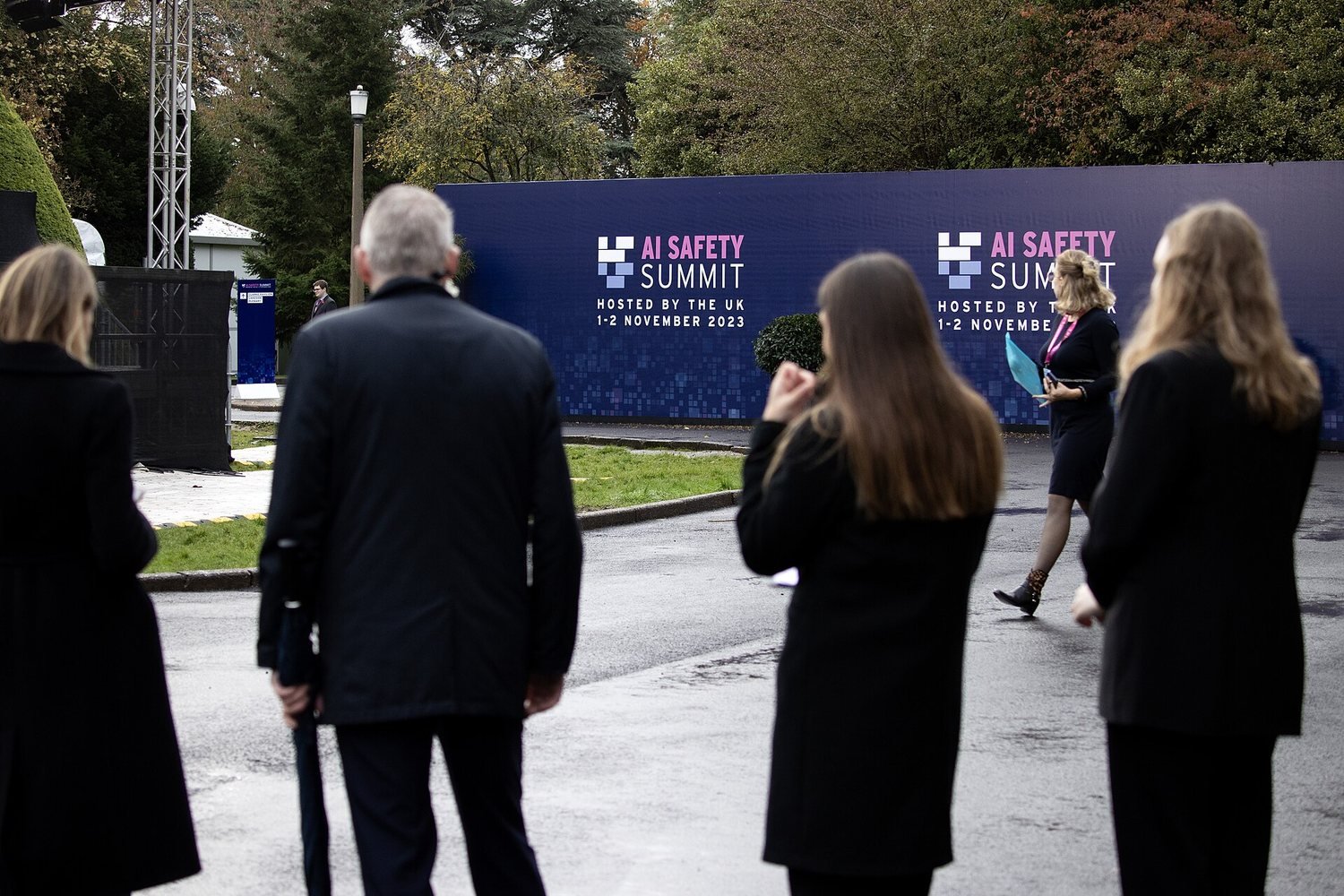
Image: Photo: UK Government via Wikimedia Commons (CC BY 2.0)
Related reading: Microsoft Routes Copilot Workloads to Its Own MAI Models — What That Means
Related Topic Express coverage
- IMF Cuts 2026 Global Growth to 3%: War Drag Meets AI Boom
- Amazon Corporate Layoffs: About 30,000 Roles Cut Since Late 2025