









Interstellar Comet 3I/ATLAS NASA Findings After is the core development covered in this report. Below is a sourced breakdown of what is confirmed, what remains uncertain, and why it matters.
Why Interstellar Comet 3I/ATLAS NASA Findings After matters now
This section focuses on the practical implications of Interstellar Comet 3I/ATLAS NASA Findings After for readers following the story — what changed, what is confirmed, and what remains open.
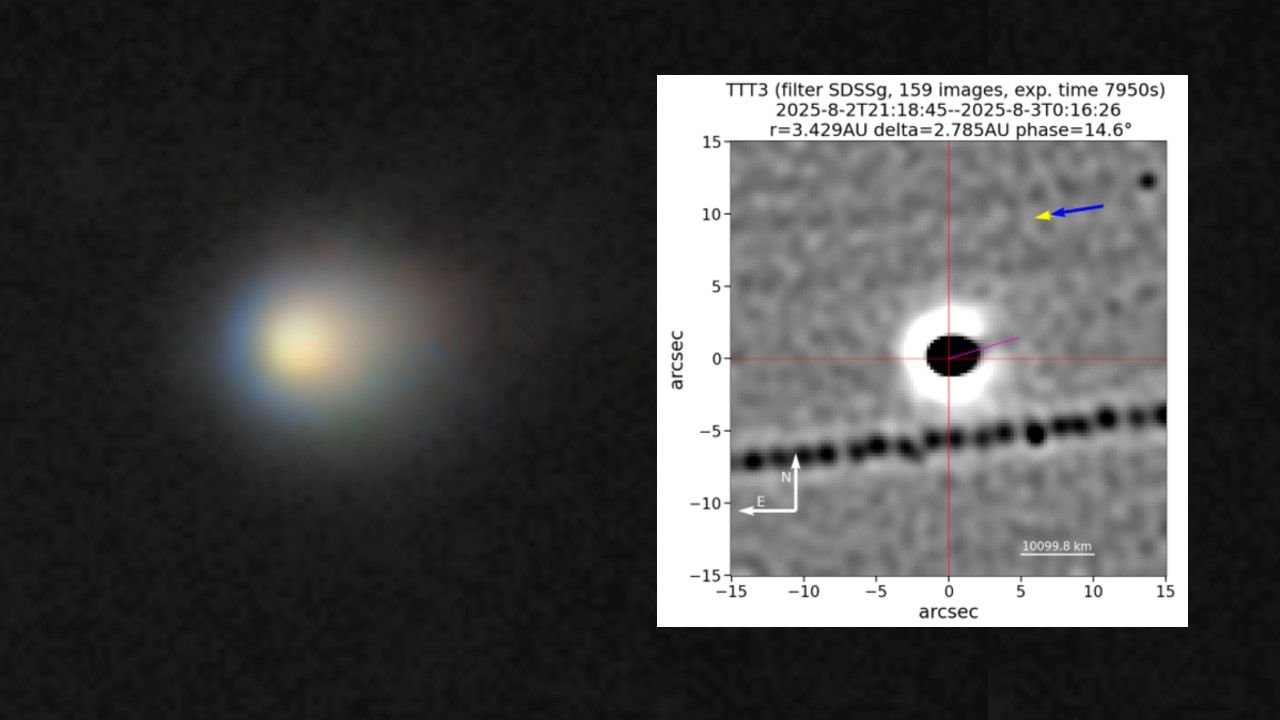
Comet 3I/ATLAS (also designated C/2025 N1) is the third confirmed interstellar object observed passing through the solar system, after 1I/ʻOumuamua and 2I/Borisov. Discovered in July 2025 by the NASA-funded ATLAS survey and reported to the International Astronomical Union’s Minor Planet Center, it followed a hyperbolic path: it was never bound to the Sun and will not return. As of mid-2026, the comet is outbound after perihelion and its closest Earth approach, while new laboratory-grade chemistry results from Webb and other observatories are refining what “interstellar” means in practice.
Key facts
- Discovery report: July 1, 2025, ATLAS telescope at Río Hurtado, Chile, to the Minor Planet Center; pre-discovery images extend to June 14, 2025.
- Status: active comet (icy nucleus plus coma), third known interstellar visitor.
- Perihelion: around October 30, 2025, about 1.4 AU from the Sun (~210 million km / ~130 million miles), just inside Mars’s orbit per NASA.
- Closest to Earth: December 19, 2025, about 1.8 AU (~270 million km / ~170 million miles). No impact threat.
- Nucleus size (Hubble, as of Aug. 20, 2025): diameter between roughly 440 meters and 5.6 kilometers.
- June 22, 2026: Nature paper using JWST NIRSpec reports extreme water D/H and carbon isotope ratios unlike Solar System comets.
Discovery and naming
NASA’s Asteroid Terrestrial-impact Last Alert System (ATLAS) first reported the object to the Minor Planet Center on July 1, 2025. The “3I” prefix marks it as the third interstellar object; “ATLAS” credits the survey. Cometary designations also record it as C/2025 N1 (ATLAS).
Astronomers classified it as interstellar because of its speed and trajectory. A hyperbolic orbit means the Sun’s gravity bent its path but could not capture it into a closed ellipse. NASA notes that when discovered it was within Jupiter’s orbital distance region, roughly 670 million kilometers from the Sun, approaching from the general direction of Sagittarius.
Activity—gas and dust released as ices warmed—established it as a comet rather than an inert asteroid-like fragment. That activity is why telescopes could measure coma composition in detail.
Timeline through the inner solar system
NASA coordinated an unusually broad observing campaign. Hubble constrained nucleus size; Webb, SPHEREx, and many planetary missions sampled brightness, dust, and gas. Spacecraft near Mars, including MRO, MAVEN, and Perseverance, obtained views when geometry favored them. Ground-based visibility dropped when the comet was near solar conjunction around perihelion, then resumed after it reappeared.
Closest solar approach occurred around October 30, 2025, at about 1.4 AU. Closest Earth approach followed on December 19, 2025, at about 1.8 AU—nearly twice the Earth–Sun distance. The IAU has stressed that thousands of astrometric observations submitted to the Minor Planet Center confirm the object never came close to Earth.
NASA’s public speed figures put discovery-era motion near 221,000 km/h, rising to about 246,000 km/h near perihelion under solar gravity, then slowing again on the outbound leg. Small non-gravitational accelerations from outgassing were reported as modest and consistent with ordinary comet physics.
What Webb and other facilities found in 2026
After perihelion, when the coma was still active, JWST NIRSpec measured major volatiles and rare isotopes. A Nature paper published June 22, 2026, led by Martin Cordiner (NASA Goddard) and colleagues, reports water deuterium enrichment of D/H = (0.98 ± 0.06)%—more than an order of magnitude above typical Solar System comet values—and elevated 12C/13C ranges for CO2 and CO.
ESA’s summary of the Webb work notes deuterium levels about 30 times those of Solar System comets and relatively little carbon-13 versus carbon-12. The team interprets those signatures as evidence for formation in a very cold environment (roughly ≲30 K in the paper’s framing) in a relatively metal-poor setting, possibly as long ago as about 10–12 billion years under Galactic chemical-evolution models. That age estimate is model-dependent, not a direct “clock reading” from the nucleus.
complementary optical work with ESO’s VLT (Opitom et al., Nature Astronomy, July 2026) reports high nitrogen and carbon isotopic ratios in CN, reinforcing that 3I/ATLAS’s chemistry is unlike familiar Solar System comets. Early Webb visits had also shown unusual CO2– and CO-rich mixing ratios that evolved through the flyby—further evidence that one interstellar sample can differ sharply from local averages.
Analysis: rare sample, easy myths
With only three confirmed interstellar visitors, every new measurement is scientifically valuable and statistically fragile. Extreme isotopes do not prove exotic technology; they constrain temperature, radiation, and metallicity in another planetary system’s ice chemistry. NASA and the IAU have both pushed back against viral claims of danger or artificial origin. In February 2026, the IAU Office for Astronomy Outreach and the Minor Planet Center launched an explicit campaign against misinformation about 3I/ATLAS.
Visibility expectations should stay modest. NASA described it as observable with small telescopes at times after perihelion into spring 2026, not as a naked-eye spectacle for casual city viewing. The lasting value is archival: open NASA datasets, MPC observations, and peer-reviewed spectra that will outlive the public attention cycle.
FAQ
Is 3I/ATLAS dangerous to Earth?
No. NASA states its closest approach was about 1.8 AU (about 270 million kilometers). The IAU Minor Planet Center’s observation set likewise shows no close-Earth approach.
Why is it called interstellar?
Its hyperbolic trajectory and speed show it was not gravitationally bound to the Sun. Tracing the orbit backward points to an origin outside the solar system.
Is it an asteroid or a comet?
A comet. Telescopes detected an icy nucleus and a coma of gas and dust released as sunlight heated the object.
How big is it?
Exact size is uncertain. Hubble-based estimates as of August 20, 2025, place the nucleus diameter between about 440 meters and 5.6 kilometers.
What is new in 2026?
Post-perihelion JWST spectroscopy published in Nature (June 22, 2026) shows extreme deuterium and carbon isotope ratios, pointing to a cold, ancient formation environment distinct from Solar System comets. Related VLT isotopic measurements appeared in Nature Astronomy in July 2026.
Primary sources
- NASA Science: Comet 3I/ATLAS overview
- NASA Science: 3I/ATLAS Facts and FAQs
- ESA: Webb finds clues to ancient origin of Comet 3I/ATLAS
- International Astronomical Union news and MPC guidance on 3I/ATLAS misinformation
- Cordiner et al., Nature (22 June 2026): isotopic evidence for cold distant origin of 3I/ATLAS
- Opitom et al., Nature Astronomy (6 July 2026): N and C isotopic ratios in 3I/ATLAS
Related reading: Webb Finds Hidden Planet Beta Pictoris d
Related Topic Express coverage
- Microsoft Routes Copilot Workloads to Its Own MAI Models — What That Means
- NASA Aqua Image Shows Oregon Wildfire Smoke Surge