








Webb Beta Pictoris d is the core development covered in this report. Below is a sourced breakdown of what is confirmed, what remains uncertain, and why it matters.
Why Webb Beta Pictoris d matters now
This section focuses on the practical implications of Webb Beta Pictoris d for readers following the story — what changed, what is confirmed, and what remains open.
Astronomers using NASA’s James Webb Space Telescope have identified a giant exoplanet in one of the Milky Way’s most closely watched young systems—and they did it without relying on a classic “dot of light” image. The world, named Beta Pictoris d, was spotted through the chemical fingerprint of its atmosphere, a result NASA announced in mid-July 2026 and published in The Astrophysical Journal Letters.
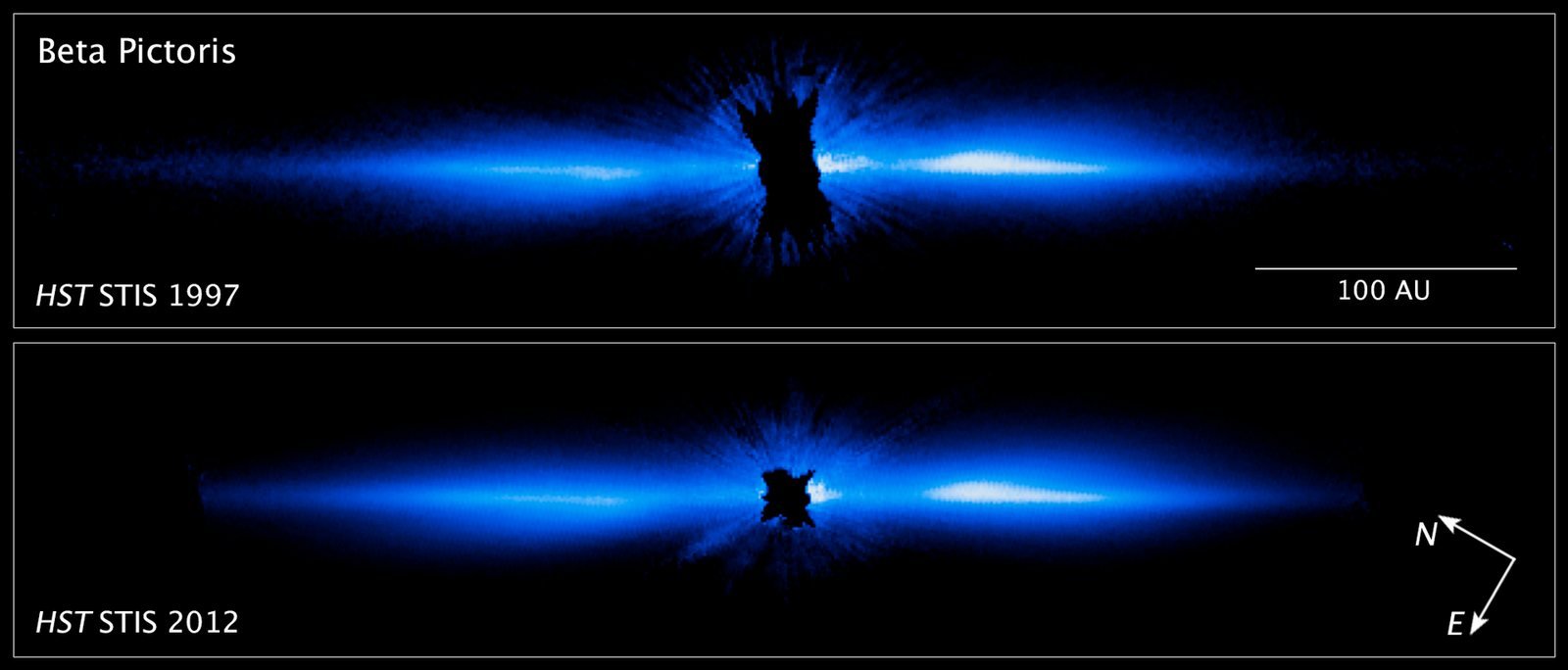
The finding adds a third giant planet to the Beta Pictoris system, already famous for planets b and c and for a bright debris disk that has long complicated imaging. According to NASA, Beta Pictoris d makes the system only the second known planetary system with at least three imaged planets—yet d itself was confirmed primarily through spectroscopy rather than traditional coronagraphic photography.
A famous laboratory for planet formation
Beta Pictoris sits about 63 light-years from Earth and is roughly 23 million years old—young by stellar standards. That youth is precisely why astronomers return to it again and again: the star still hosts a disk of dust and debris left over from planet formation, offering a rare window into how newborn worlds interact with leftover material.
Beta Pictoris b was among the first exoplanets ever directly imaged. Beta Pictoris c followed. Modeling and disk structure had long hinted that another body might help explain the disk’s sharply defined inner edge and other puzzling features. NASA notes that astronomers had already predicted a planet like Beta Pictoris d to account for those structures—making the new detection both a surprise in the data and a confirmation of earlier theoretical expectations.
Not looking for a planet—then the barcode appeared
Lead author Aidan Gibbs, a postdoctoral researcher at the University of California, San Diego, and colleagues were using Webb’s NIRSpec (Near-Infrared Spectrograph) Integral Field Unit to study the atmosphere of Beta Pictoris b when the unexpected signal appeared. The IFU collects both an image and a spectrum at every pixel—an approach that proved decisive.
“We weren’t looking for a new planet,” Gibbs said in NASA’s release. “We were trying to understand one we already knew existed. Then, this telltale signal appeared in the data where we didn’t expect it.”
Instead of a smooth spectrum from light bouncing off dust, the team saw peaks and troughs matching carbon monoxide absorption lines—a barcode-like pattern expected in giant-planet atmospheres. Spectroscopy also encodes motion: from the same data, researchers extracted radial velocity information. The planet’s speed, position, and alignment with the debris disk were consistent with an object orbiting Beta Pictoris, not a background star or a brown dwarf with carbon monoxide in its atmosphere.
Jean-Baptiste Ruffio of UC San Diego, principal investigator of the first Webb observations that yielded the discovery, stressed why spectra matter more than bright blobs alone: unexpected bright sources can be instrumental artifacts or disk structures. “By obtaining a spectrum at the same time as the image, we were able to quickly confirm our suspicions,” he said.
What astronomers think Beta Pictoris d is like
NASA reports that Beta Pictoris d is likely at least twice the mass of Jupiter, making it the smallest of the three known giant planets in the system. Modeling suggests an orbital distance of roughly 30 astronomical units—comparable to Neptune’s region in our solar system. That is the widest orbit among the three known planets, yet still inside the inner edge of the debris disk.
Follow-up observations with Webb’s MIRI (Mid-Infrared Instrument), obtained through Director’s Discretionary Time, detected water vapor and methane, further supporting the planet’s identity and enriching the atmospheric picture. Unlike traditional imaging campaigns that often discover a point source first and characterize it later, the spectroscopic route let researchers begin studying temperature, chemistry, and motion from the first confirmation.
A separate imaging study led by Ben Sutlieff of the University of Edinburgh and Markus Bonse of the European Southern Observatory, using the Very Large Telescope plus Webb’s NIRCam, independently confirmed Beta Pictoris d’s existence—bolstering confidence that the spectroscopic signal corresponds to a real world.
Seeing through cosmic fog
Why did such a nearby, well-studied system hide a giant planet for so long? NASA’s answer is the debris disk itself. One of the brightest known, it scatters starlight like fog, making it hard for conventional imaging to separate planets from disk structures. Moderate-resolution spectroscopy effectively sidestepped that fog by isolating narrow molecular signatures unique to a planetary atmosphere.
NASA frames the result as the first directly imaged planet discovered primarily through moderate-resolution spectroscopy—evidence that atmospheric fingerprints can reveal worlds in complex environments where coronagraphs alone struggle. The team plans further analysis of temperature, composition, and orbit to refine the portrait of this iconic system.
Why the method could change exoplanet searches
Direct imaging has delivered some of astronomy’s most striking exoplanet portraits, but it is biased toward young, massive, widely separated planets around nearby stars—and it can fail when dust is bright. Transit and radial-velocity surveys excel at closer-in worlds but do not always map cold giants at large separations with atmospheric detail from day one.
Webb’s IFU approach sits in a powerful middle ground: it can find a planet and immediately begin characterizing its atmosphere. If similar techniques scale to other debris-disk systems, astronomers may uncover “hidden” companions that imaging surveys have overlooked for decades. Beta Pictoris d is therefore both a local discovery and a methods story—one that may reshape how observatories prioritize follow-up on young, dusty systems.
Webb itself is an international partnership led by NASA with ESA and the Canadian Space Agency. Continued observations of Beta Pictoris will test how well spectroscopic discovery generalizes beyond this celebrated laboratory.
Putting Beta Pictoris d in context
For decades, Beta Pictoris has been a teaching case for how disks and planets co-evolve. Direct images of Beta Pictoris b demonstrated that young giants can be bright enough in infrared to be resolved from their host stars. Measurements of Beta Pictoris c complicated dynamical models and raised new questions about how multiple giants share a compact, dusty nursery. Beta Pictoris d now extends that census outward, closer to the debris disk’s inner edge, where gravitational shepherding can sculpt dust into sharp boundaries.
That geometry matters for formation theory. A roughly Neptune-distance giant that is still less massive than its siblings suggests a system that assembled multiple gas-rich worlds across a wide range of separations while leftover planetesimals continued to collide and grind into dust. If d helps maintain the disk’s inner cavity, future dynamical simulations can test whether one planet is enough or whether the combined architecture of b, c, and d is required. Webb’s ability to return atmospheric chemistry alongside orbital clues means those simulations will be constrained by more than mass and separation alone.
The discovery also illustrates a practical observing strategy for other bright-disk systems: schedule IFU spectroscopy on a known planet, then inspect the full field for unexpected molecular barcodes. Many “failed” imaging campaigns may still contain unused spectroscopic gold. As archives of NIRSpec and MIRI observations grow, systematic re-analysis could yield additional hidden companions—especially where dust once defeated coronagraphs. Beta Pictoris d is therefore both a destination and a template.
FAQ
Was Beta Pictoris d photographed like Beta Pictoris b?
Not in the classic sense. NASA emphasizes that d was identified primarily through spectroscopic chemical signatures (including carbon monoxide, later water vapor and methane), not by spotting a bright point of light first. Independent imaging later supported the detection.
How many planets does Beta Pictoris have now?
At least three known giant planets—b, c, and newly identified d—making it only the second system known to contain at least three imaged planets, according to NASA.
Where is the research published?
The discovery study was published in The Astrophysical Journal Letters, with NASA’s public summary dated July 15, 2026.
Primary sources
Related coverage
Readers following Webb exoplanet science may also revisit NASA’s earlier Beta Pictoris features on the system’s dusty “cat’s tail,” icy debris suggestive of shepherding planets, and broader explainers on how space telescopes break starlight into spectra. Those stories provide useful context for why a third giant at ~30 AU fits both the new data and long-standing disk puzzles.
Image: Image: NASA/ESA via Wikimedia Commons (public domain)
Related reading: Perseverance Finds Ancient Mars Rock Stack Built by Asteroid Impacts
Related Topic Express coverage
- Digital Arrest Offence: Supreme Court Tells Centre to Define It in Law
- Perseverance Finds Ancient Mars Rock Stack Built by Asteroid Impacts