







Delhi NEET protests 2026 is the core development covered in this report. Below is a sourced breakdown of what is confirmed, what remains uncertain, and why it matters.
Why Delhi NEET protests 2026 matters now
This section focuses on the practical implications of Delhi NEET protests 2026 for readers following the story — what changed, what is confirmed, and what remains open.
Between May and late July 2026, India’s medical-entrance system and a youth-led street campaign collided. The National Testing Agency (NTA), with Government of India approval, cancelled the NEET-UG 2026 exam held on 3 May 2026 after investigative inputs on paper-leak allegations, then reconducted the test on 21 June 2026. Student anger, already high after earlier exam controversies, fed a Delhi-centred agitation led by the Cockroach Janta Party (CJP). By 25 July 2026, Union Education Minister Dharmendra Pradhan had resigned. On 28 July 2026, the Supreme Court issued interim directions on arrests, evidence preservation and coercive action.
This explainer separates what official agencies and court reporting have established from protest claims that remain unverified.
Key facts at a glance
- NEET-UG 2026 original date: 3 May 2026 (about 22–24 lakh candidates, per reporting of NTA figures)
- Cancellation: NTA announcement on 12 May 2026, with central government approval
- Re-examination: 21 June 2026 (pen-and-paper; existing registrations used; no fresh fee, per NTA advisories reported)
- Investigation: Case referred to the CBI for a comprehensive inquiry (government/ministerial statements and contemporaneous reporting)
- Delhi flashpoint: CJP sit-in at Jantar Mantar; “Sansad Chalo” march on 20 July 2026
- Political outcome: Dharmendra Pradhan resignation letter/public confirmation on 25 July 2026
- Judicial update (28 July 2026): Supreme Court interim order on minors’ release, evidence preservation, limits on coercive action
What happened to NEET-UG 2026
After the 3 May exam, agencies examined reports that question material had circulated in advance, including inputs linked to Rajasthan and other states. NTA said investigative findings meant the May process “could not be permitted to stand.” The agency cancelled the exam in the stated interest of protecting trust in the national system and announced a fresh test. Candidates were told existing registrations would carry over and that fees already paid would be refunded, with no additional examination fee for the re-test.
NTA later fixed the re-exam for Sunday, 21 June 2026, in offline mode across cities in India and abroad, with a published window for address/city updates. The Centre publicly framed the response as including cancellation, CBI investigation, and a later policy intent to move NEET toward computer-based testing in a subsequent cycle—points repeated in Pradhan’s July resignation letter as reported by major outlets.
How the CJP protest grew
CJP began as an online satirical youth campaign and, after organiser Abhijeet Dipke’s return to India, shifted to physical mobilisation. Its first major Delhi gathering at Jantar Mantar is widely dated to early June 2026, with demands focused on accountability for exam leaks, broader public-exam reforms, and the resignation of the Union education minister.
The unusual name was framed by supporters as reclaiming a pejorative “cockroach” label aimed at sections of unemployed youth and activists. Whatever one thinks of the branding, the street campaign became a national political story because it linked a concrete exam failure to a simple accountability demand.
Sonam Wangchuk’s hunger strike
Engineer and education activist Sonam Wangchuk joined the Jantar Mantar agitation and began an indefinite hunger strike on 28 June 2026, in solidarity with demands over NEET irregularities and related student concerns. In mid-July, after roughly three weeks of fasting, Delhi Police shifted him to VMMC and Safdarjung Hospital, citing medical advice and Delhi High Court directions. Hospital bulletins described stable vitals with altered blood parameters and physiological stress from prolonged fasting; reporting also noted disputes over consent for intravenous treatment.
Wangchuk’s hospitalisation intensified attention on the sit-in but did not, by itself, resolve the ministerial accountability demand.
20 July 2026: Sansad Chalo and the police response
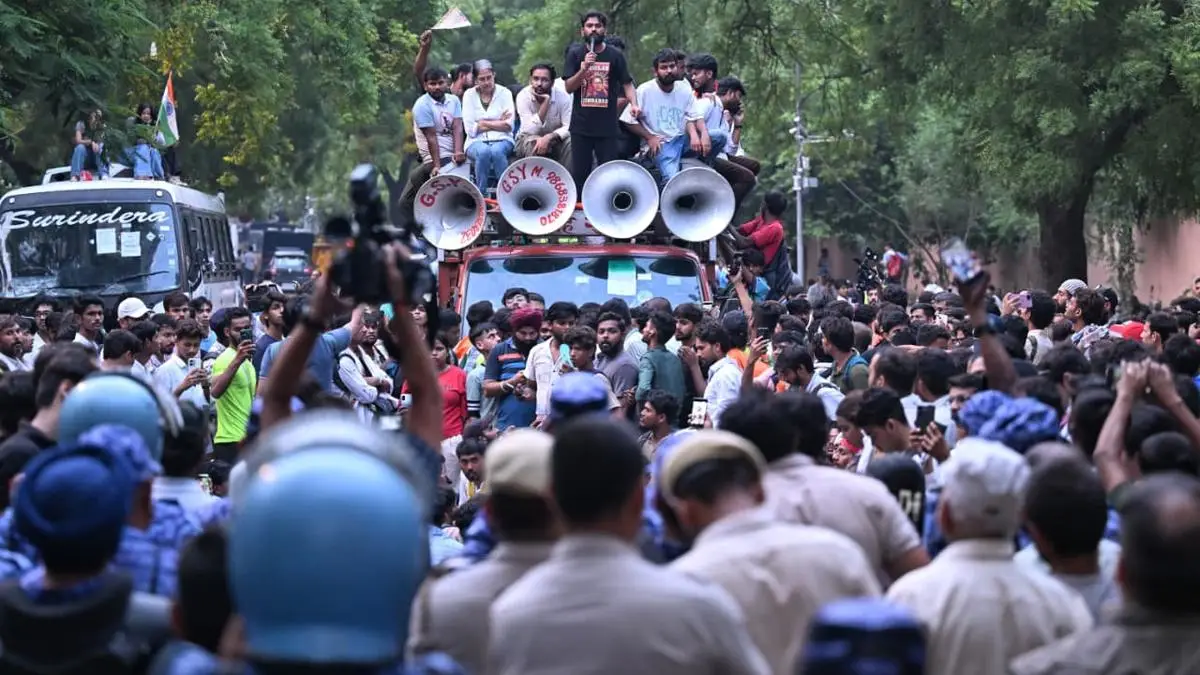
On 20 July 2026, as Parliament’s monsoon session context heightened stakes, CJP attempted a march toward Parliament from Jantar Mantar. Delhi Police had signalled that a Parliament approach would not be permitted. Large crowds still spilled across central Delhi corridors. Police used barricades, baton charges and tear gas at multiple points. Some protesters, according to police and news agency accounts, threw stones and damaged property.
Delhi Police said more than 118 personnel were injured and about 70 protesters were detained, with FIRs initiated. Metro stations in the core were closed for security. Mobile internet was suspended in parts of central Delhi. Injury counts on the protester side vary by outlet; treat precise civilian casualty tallies as still contested pending independent investigation.
Talks with J.P. Nadda and the demand charter
Also on 20 July, CJP representatives submitted a memorandum to Union Health Minister J.P. Nadda. Reported core demands included: resignation or removal of Dharmendra Pradhan; release/free movement for Sonam Wangchuk; and compensation for families of aspirants who, according to CJP’s own count, had died by suicide after the leak controversy. Nadda’s side indicated the points would be taken up with the leadership. No same-day comprehensive settlement was announced.
Important caveat: CJP’s suicide totals are the organisation’s claim. They should not be published as an official government statistic unless backed by a named official dataset.
25 July 2026: Resignation and protest wind-down
On 25 July 2026, Dharmendra Pradhan announced he had tendered his resignation to Prime Minister Narendra Modi. In a letter addressed to the country’s youth, he said irregularities in the 3 May exam led the government to refer the matter to the CBI, cancel the test and schedule a re-exam, and he framed resignation as protecting students from prolonged political/legal entanglement. Subsequent reporting said President Droupadi Murmu accepted the resignation on the Prime Minister’s advice and that Pralhad Joshi was appointed education minister.
After further talks, ministers including Nadda and Jitendra Singh publicly indicated the government had accepted key CJP demands: examining a reform charter, compensation pathways under applicable rules, and relief on FIRs against protesters, alongside the ministerial change. CJP then announced it was ending the agitation and asked supporters to disperse. Implementation details of every administrative promise should be tracked against later official orders—not assumed complete on announcement day.
28 July 2026: Supreme Court interim directions
Hearing petitions alleging police excesses (and noting injuries to police personnel as well), a Supreme Court bench headed by Chief Justice of India Surya Kant, with Justices Joymalya Bagchi and V. Mohana, issued interim directions on 28 July 2026. In substance, as reported by PTI/All India Radio and detailed court reporting:
- Preserve CCTV, drone, body-worn camera, wireless and PCR-related digital evidence
- Keep protesters’ personal digital data preserved but out of the public domain for now
- Allow FIR investigations to continue, but bar coercive action against protesting students without criminal antecedents
- Direct states to release detained/arrested persons under 18 without criminal antecedents (bond if required)
- Seek state responses; indicate that allegations prima facie warrant considering a fair, independent probe covering violence against students and police
Confirmed vs uncertain
Confirmed: cancellation and reconduct of NEET-UG 2026; CJP-led Delhi protests culminating in the 20 July clash; ministerial resignation on 25 July; Supreme Court interim order on 28 July.
Uncertain or disputed: exact turnout; full injury accounting; pellet-related claims (police have disputed some versions); whether every compensation/FIR promise has been fully executed; and the final shape of any court-ordered independent probe.
FAQ
Why were students protesting in Delhi?
Primarily over the NEET-UG 2026 paper-leak cancellation trauma, distrust in public exams, and demands for ministerial accountability and reform.
Was NEET-UG 2026 actually cancelled?
Yes. NTA cancelled the 3 May 2026 exam with government approval and held a re-exam on 21 June 2026.
Did Dharmendra Pradhan resign?
Yes. He announced resignation on 25 July 2026 amid the protests; reporting confirmed acceptance and a successor appointment.
What did the Supreme Court order on 28 July?
Interim directions to preserve evidence, protect protester data from public release, limit coercive action against students without criminal antecedents, and release eligible minors—while allowing FIR probes to continue.
Primary sources
- National Testing Agency communications on NEET-UG 2026 cancellation and re-exam
- Ministry of Education / Union minister statements and resignation materials
- Delhi Police statements on July 2026 protest injuries and detentions
- Supreme Court of India — interim directions of 28 July 2026 as reported
- Safdarjung Hospital / VMMC medical updates related to the protests
Developing legal and administrative story. Figures attributed to police, protesters or secondary tallies are labelled as such.
Related reading: Dharmendra Pradhan Resigns Amid NEET Protests
Related Topic Express coverage
- Dharmendra Pradhan Resigns as Education Minister Amid NEET Protests
- SSI and NVIDIA’s Vera Rubin Deal: What Was Confirmed