










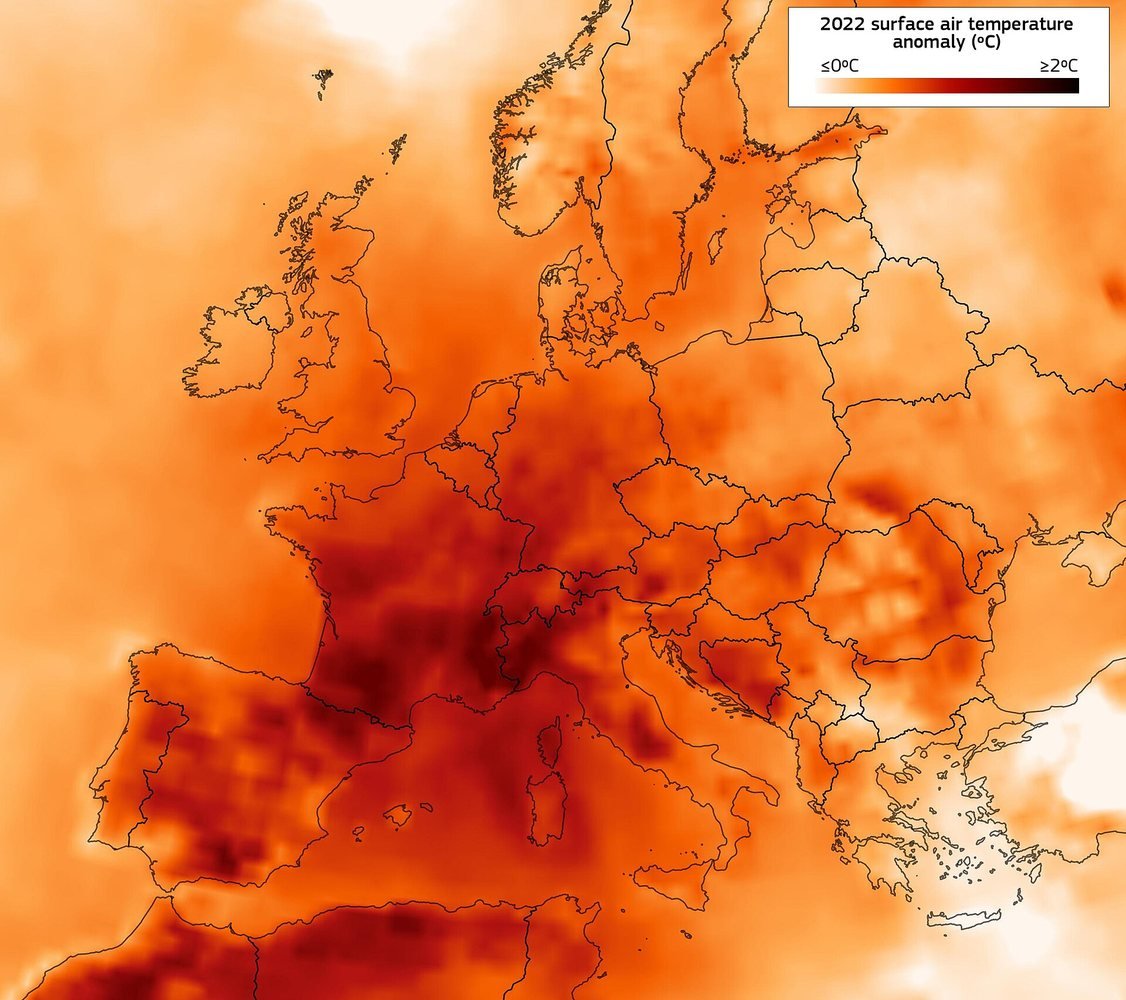
Western Europe hottest June 2026 is the core development covered in this report. Below is a sourced breakdown of what is confirmed, what remains uncertain, and why it matters.
Why Western Europe hottest June 2026 matters now
This section focuses on the practical implications of Western Europe hottest June 2026 for readers following the story — what changed, what is confirmed, and what remains open.
June 2026 was the hottest June on record for western Europe and the second-warmest June globally, according to the Copernicus Climate Change Service (C3S), implemented by the European Centre for Medium-Range Weather Forecasts (ECMWF). The July 9, 2026 bulletin ties the extremes to a late-month heatwave on land, record-high sea-surface temperatures for the month, and a climate system that continues to accumulate heat.
“June 2026 underscored how profoundly the climate is changing,” said Samantha Burgess, Strategic Lead for Climate at ECMWF. “Western Europe recorded its warmest June on record, and continued record warmth in the global ocean. Together, these records reflect a climate system continuing to accumulate heat.”
The numbers behind western Europe’s record
For the western Europe domain used by C3S (11°W–15°E, 37°–55°N), June 2026 averaged 20.74°C—3.06°C above the 1991–2020 June average—surpassing the previous regional June record set in June 2025. Europe as a whole (land only) posted its second-highest June on record at 19.14°C, or 1.78°C above the 1991–2020 mean, behind June 2019.
Globally, June 2026 averaged 16.54°C in the ERA5 dataset—0.56°C above the 1991–2020 June average—trailing only June 2024. Relative to the estimated pre-industrial 1850–1900 baseline, the month was 1.39°C warmer.
A late-June heatwave after May’s extremes
Copernicus highlights an intense heatwave across much of western and central Europe in the second half of June, following a particularly intense May heatwave and with another heat episode emerging in early July. Many June records—and some all-time daily maximum records—were broken in several countries. C3S notes severe health impacts, including heat-related deaths, underscoring that successive extremes are not isolated curiosities but a mounting public-health challenge.
Average anomalies mapped for 18–30 June 2026 show how concentrated the late-month warmth was relative to the 1991–2020 reference. The bulletin frames the succession of heatwaves as evidence of increasingly frequent and intense heat extremes across Europe and the globe.
Oceans at record June warmth—and El Niño’s shadow
Sea-surface temperatures amplified the story. The average SST for extra-polar oceans (60°S–60°N) in June 2026 was the highest on record for the month at 20.86°C, edging June 2024 by just 0.01°C. C3S notes exceptionally high SSTs across a large portion of the tropical Pacific where El Niño conditions are present and forecast to strengthen rapidly in coming months—context for why global ocean heat remains a central monitoring priority.
Marine heatwaves also affected the western Mediterranean and Atlantic coasts, pairing terrestrial extremes with coastal and marine stress. ERA5 SSTs reflect foundation temperatures near ~10 m depth; C3S cautions that results can differ from products estimating temperature at other depths.
Dry soils, wildfires, and uneven rainfall
Heat did not arrive alone. Much of western continental Europe—including Italy, large parts of central and eastern Europe, and the southern UK—saw drier-than-average conditions linked to persistent high pressure. Dry soils that had begun developing during May’s heatwave worsened drought risk in parts of eastern Europe and contributed to wildfire activity, particularly in the Iberian Peninsula and southern France.
River flow ran below average across large parts of France, central and eastern Europe, and portions of northeastern Europe. By contrast, Iceland, Ireland, much of the UK, the North Sea coast, Fennoscandia, the Baltic States, Greece, and a region north of the Caspian Sea were wetter than average, with localized flooding in some places. The patchwork matters: Europe’s June climate was not uniformly “hot and dry,” but the heatwave core coincided with hydrological stress that compounded impacts.
Sea ice and the wider June picture
Arctic sea-ice extent in June averaged about 5% below the reference average (sixth-lowest for the month), with notably low cover in the northern Barents Sea around Svalbard and Franz Josef Land. Antarctic June extent was about 8% below average (also sixth-lowest), with much-below-average cover in the Bellingshausen Sea and above-average cover in the Amundsen and eastern Ross Seas.
Globally, wetter-than-average pockets appeared in parts of North America, easternmost Asia, southern Africa, and Australia, while drier conditions affected parts of the USA and Canada, South America, the Middle East, Central Asia, and Russia. Copernicus’s monthly updates deliberately combine air temperature, ocean heat, hydrology, and ice to show how extremes interconnect.
How to read the records responsibly
C3S uses ERA5 and ERA5-Land and follows WMO guidance in referencing the 1991–2020 climatology for bulletins from January 2021 onward. “Warmest on record” statements depend on the dataset start (ERA5 rankings cited here reach back through 1979 for some extreme categories) and on the exact geographic box. Western Europe’s June record and Europe-wide rankings are related but not identical metrics—precision that matters when headlines compress complex maps into a single phrase.
National record lists and impact tallies draw on national and regional reports; readers seeking station-level detail should consult the full C3S climate bulletin and national meteorological services. What the continental signal already shows is unambiguous: western Europe’s June 2026 warmth was exceptional against both recent and longer baselines, arriving with ocean heat near record levels and compounding drought and fire risk.
Impacts beyond the temperature charts
Record monthly averages are statistical summaries; lived experience arrives as sleepless nights, strained emergency services, crop stress, and strained power grids. Copernicus explicitly links the June heatwave sequence to health impacts, including heat-related deaths, and to wildfire activity where dryness and heat coincided. Those impacts are uneven: coastal marine heatwaves threaten fisheries and tourism differently than inland drought threatens agriculture and river navigation.
The bulletin’s hydrological contrast—dry west-central corridors versus wetter northern and some southern pockets—shows why national preparedness cannot rely on a single European narrative. Flooding in one region can occur in the same month another region faces fire weather. Adaptation planning therefore needs both continental monitoring from services like C3S and local early-warning systems that translate ERA5-scale anomalies into city-level heat-health alerts.
Ocean context also matters for Europe’s coasts. Record or near-record June SSTs and Mediterranean/Atlantic marine heatwaves can intensify humidity, alter storm environments, and stress ecosystems already facing cumulative warming. The narrow 0.01°C margin by which extra-polar June SSTs topped 2024 is a reminder that recent years sit in a tight cluster of extremes; “second warmest” globally does not imply a return to older norms.
Looking ahead, C3S notes El Niño conditions in the tropical Pacific that were present in June and forecast to strengthen. While El Niño is a Pacific-centered mode, its teleconnections can influence seasonal outlooks worldwide. European users should watch subsequent Copernicus monthly updates through summer and autumn for whether western Europe’s June spike is a one-month outlier or part of a sustained warm season—especially given May’s intense heat and early-July follow-on warmth described in the same release.
For journalists and educators, the cleanest accurate framing is: western Europe set a June record; Europe overall had its second-hottest June; the globe had its second-hottest June; oceans hit a June SST record by a razor-thin margin; and land extremes arrived with drought and fire risk in key regions. That multi-metric summary matches the primary Copernicus release more faithfully than any single superlative.
FAQ
Was June 2026 the hottest June ever, worldwide?
No. Globally it was the second-warmest June in ERA5, behind June 2024. Western Europe specifically set a June record.
What temperature anomaly did western Europe see?
An average of 20.74°C, or 3.06°C above the 1991–2020 June average, according to Copernicus/C3S.
Did ocean temperatures also break records?
Yes for the month: extra-polar ocean SSTs averaged 20.86°C, the highest June value on record in the ERA5-based C3S analysis, narrowly above June 2024.
Primary sources
Related coverage
For ongoing monitoring, Copernicus points readers to Climate Pulse for near-real-time global indicators, the Climate Atlas for trends and projections, and the ERA Explorer app for dataset access. Prior C3S monthly bulletins on May 2026 heat and marine heatwaves provide the immediate backdrop to June’s western European record.
Image: Image: European Union, Copernicus Climate Change Service
Related reading: Perseverance Finds Ancient Mars Rock Stack Built by Asteroid Impacts
Related Topic Express coverage
- Meta and BlackRock’s $14B El Paso AI Campus Deal
- Origin Energy Breach: 900,000 Customers and What’s Next